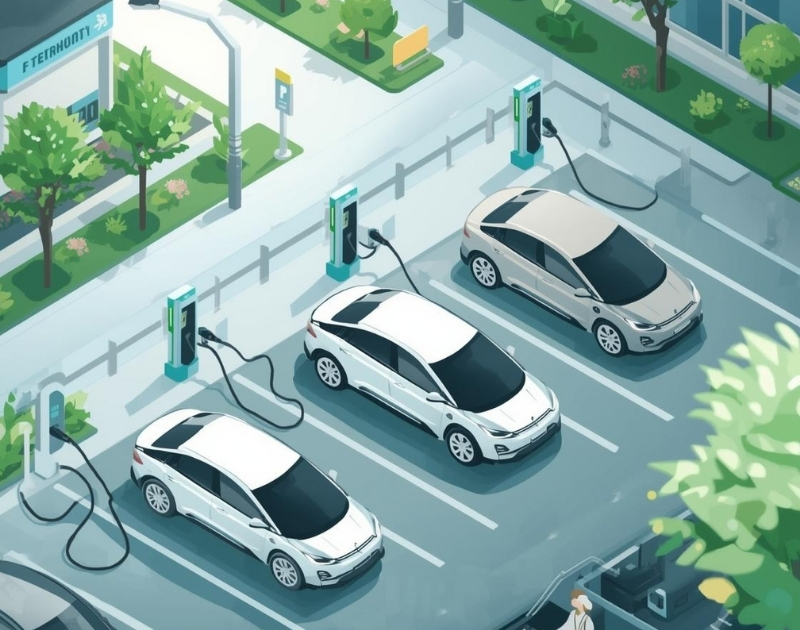



For CFOs and fleet managers, 2025 marks a major strategic turning point. The transition to an electric fleet is no longer just a regulatory requirement linked to the LOM Law it is now a documented and measurable driver of economic performance.
The October 2025 Enedis report, based on a survey of 600 French companies, delivers clear-cut conclusions: technological maturity has been reached, user satisfaction is at an all-time high, and most importantly, profitability is being achieved.
At Oriway, we have analyzed this study to extract the performance indicators that truly matter for your mobility strategy. Here is what the field data reveals regarding actual usage, operating costs, and smart charging management.
The first key takeaway from the Enedis report definitively validates the user experience of professional electric fleets.
94% of companies that have electrified their fleet report being satisfied with their all-electric or plug-in hybrid vehicles. This exceptional figure dispels classic operational concerns: technical reliability, employee acceptance, and suitability for business needs. This remarkably high number provides reassurance regarding the reliability of current technologies and employee buy-in.
For a CFO, this indicator means that the transition risk is now under control. The disruptions feared during the switch to electric (user complaints, loss of productivity, breakdowns) are not materializing in the field.
Among the companies that have taken the leap:
This transformation is no longer marginal: it is redefining the composition of French vehicle fleets.
The argument of insufficient range, long seen as the main barrier to adopting an electric corporate fleet, is invalidated by 2025 real-world usage data.
Average daily distance traveled:
The gap is now only 9 km per day. Even more telling: EVs now travel 36 km more per day than in 2024 (a 52% increase). This growth reflects a better understanding of advertised range and increased driver confidence.
For a fleet manager, these figures confirm that electric vehicles can now handle service and operational tasks without compromising productivity. Range is no longer a deciding factor when choosing a powertrain for the majority of professional use cases in France.
Contrary to popular belief, 49% of companies choose electrification for economic reasons, far ahead of environmental motivations (29%).
Savings on fuel expenses are spontaneously cited as the primary benefit observed. This hierarchy of priorities validates the TCO (Total Cost of Ownership) approach: it is no longer the purchase price that matters, but the total cost over the ownership period.
The 2025 report highlights a dramatic professionalization of energy management :
36% of companies now manage charging (compared to just 21% in 2024), an increase of +71% in one year.
Primary motivations for management:
This smart management is carried out via:
This trend is transforming charging from a simple cost center into an active financial optimization lever.
Equipping professional sites is shifting toward pragmatic rather than flashy solutions :
Breakdown of installed power in 2025:
Unlike the race for power seen in the public sector, 60% of companies prefer standard or reinforced sockets, which are perfectly suited for long parking durations (full or half days).
Among companies with a parking lot (76% of them):
This openness is a rapidly growing employee benefit, strengthening employer attractiveness.
The Enedis report identifies a clear divide : companies that have not yet started electrification are mostly small organizations with an average of 8 vehicles.
These companies are not subject to the requirements of the LOM Law, which primarily targets fleets of over 100 vehicles. Without legal constraints, inertia is widespread:
A telling paradox: these fleets travel an average of 87 km/day, a usage profile that is 100% technically compatible with electric vehicles.
Identified barriers:
These figures reveal a lack of awareness regarding the actual TCO : by focusing solely on the purchase price, these companies are missing out on structural savings over 3 to 5 years.
While the data shows that technological maturity has been reached, implementation remains a complex organizational challenge.
The complexity of installing charging stations and managing charging are cited as obstacles by 16% and 17% of non-equipped companies, respectively. Also worth noting are the 11% of these companies that mention resistance from employees or management.
Switching to an electric fleet is about more than just buying vehicles. It is a complete ecosystem to deploy:
While 2025 marked the validation of the technological and economic maturity of electric fleets, 2026 will be the year of concrete regulatory deadlines.
For companies with over 100 vehicles, LOM Law requirements are intensifying:
Is your fleet aligned with the 2026 requirements? With your current electrification rate, are you compliant or at risk of sanctions?
Have you calculated your actual 3-5 year TCO? Beyond the purchase price, how much are you really saving on fuel, maintenance, and taxes?
Is your charging infrastructure optimized? Do you have energy management in place to reduce your electricity bill by 20 to 30%?
Are your employees trained and supported? A 94% satisfaction rate doesn't happen by accident: it is the result of structured change management.
Evolution of grants and incentives
Purchase support schemes are changing. How can you optimize your acquisition timeline to maximize subsidies?
The rise of Vehicle-to-Grid (V2G)
Your fleet could become an energy asset: storage, resale to the grid, and peak load management. Are you equipped for this revolution?
Pressure on the power grid
With the growth of electric fleets, smart charging management is becoming critical. Is your energy strategy sustainable in the face of rising rates?
The 2025 Enedis report proves it: 94% satisfaction, 105 km real-world range, structural energy savings. Maturity has been reached.
But between LOM 2026 compliance, TCO optimization, and energy management, every decision impacts your profitability for the next 3 to 5 years.
At Oriway, we analyze your fleet in 48 hours and reveal:
Data source: Enedis report "Corporate electric vehicle usage and charging" - October 2025.