


On March 12, 2026, Paris buzzed with the rhythm of Flotauto Expo, the essential annual event for every fleet manager. For Oriway, this edition marked a historic turning point: electrification is no longer a peripheral topic or a simple CSR box to check. It is now the beating heart of the economic, regulatory, and operational challenges facing French companies.
Between the conferences, discussions, innovations in charging, and new SaaS fleet management solutions, one question dominated every conversation: how can we electrify profitably while managing increasingly complex charging costs?
In this recap of the 2026 edition, we look back at the key takeaways from this iconic event for mobility professionals, covering five main areas: the new economic and regulatory landscape, the transformation of TCO, charging policy, the central role of data and AI, and finally, the concrete impact on commercial vehicles, last-mile delivery, and innovation.
We leave this edition with one conviction: there is now a clear need for 360° solutions capable of driving the energy transition of fleets by tackling both charging costs and operational complexity.
The event highlighted the profound transformation of the fleet manager's role. We are no longer just managing "cars," but a hybrid ecosystem where energy meets data and human resources.
Three major trends emerged from the show floor:
Controlling the costs of your electric fleet requires precise management of the vehicle's entire lifecycle.
With the massive influx of electrified vehicles, the calculation of total cost of ownership has changed radically. The energy TCO must now include:
The challenge now lies in comparing complete scenarios: internal combustion vs. hybrid vs. electric, while taking into account real driving profiles, traffic zones, and the ability to charge under optimal conditions.
The event highlighted concrete levers for regaining control over budgets: negotiating mileage parameters rather than just the monthly payment, and standardizing return procedures to avoid unexpected refurbishment fees.
The Oriway perspective: The post-show trend is clear. It is advisable to internalize strategic vision and data through high-performance SaaS software, while entrusting standardizable operational tasks to expert partners.
The "Fleet Management: What Should Be Outsourced?" conference sparked a fundamental debate at the show: how far should management be delegated to external providers in a context of sustainable mobility complexity?
Operational outsourcing
It provides essential expertise and resource pooling for time-consuming areas such as claims management, traffic ticket processing, remarketing, or roadside assistance. It is the ideal lever for standardizing administrative-heavy tasks.
Strategic internalization
It is considered crucial for maintaining control over the Car Policy, energy trade-offs, and integration with internal systems (Finance, HR, IT). The manager thus remains the guarantor of the long-term vision.
The major trend from Flotauto 2026 on this subject
Strategy is no longer delegated. Companies are now choosing to keep decision-making vision in-house while relying on fleet management SaaS solutions such as Oriway Business.
By centralizing the charging data and tracking TCO on a proprietary platform, the manager can oversee their specialized partners while maintaining full control over their electrification roadmap. The idea is simple: entrust execution to the experts, but keep the software intelligence at the heart of the company.
Expert insights Oriway at the show confirm it: electrification is the beating heart of the Flotauto 2026event. The strategic conferences ("Electrifying your fleet: what companies are actually doing", "Electrification: what are the challenges and solutions?") marked a paradigm shift. The question is no longer whether to switch to sustainable mobility, but how to orchestrate this transition without blowing the company budget.
The market is currently seeing a three-stage progression, where data has become the key to success:
Despite the willingness of fleet managers, four major barriers were identified during the discussions at Flotauto:
Oriway's take: to overcome these obstacles, a 360° SaaS approach is essential. Our platform reconciles this scattered data to provide a crystal-clear view of energy TCO, turning operational complexity into a driver of economic performance.
Conferences dedicated to “High-mileage EV drivers” and “Electric SUVs” confirmed that the manufacturer market has matured: the current range is broad enough to cover 90% of business needs. However, Flotauto 2026 drove home a strong message: vehicle allocation decisions can no longer be based on intuition or global averages.
To ensure a TCM that performs, the choice of powertrain must be based on the real-world usage data management:
The Oriway Business approach: an optimized fleet in 2026 is not necessarily 100% electric. Success relies on a smart energy mix. Our SaaS solution identifies driving profiles eligible for EVs with high precision, preventing costly assignment errors.
The “2026 Charging Policy” and “Charging management: which methods?” were unanimous: infrastructure alone is useless without strict governance integrated into your Car Policy. For Oriway Business, this policy must answer three fundamental questions for your sustainable mobility :
Feedback (such as Vaylens’ “5 actions to regain control” or Schneider Electric’s case study on electrifying a heavy-duty fleet) proves that successful electrification is not just about purchasing equipment, but a 360° project approach. This begins with a serious sizing study and ends with continuous charging cost optimization.
The major trend observed during these Flotauto 2026 meetings in Paris is the central role of digital tools. Strategic conferences (“GAC Software,” “Telematics: how to get the most out of it?”, “Fuel and multiservice cards,” and “Artificial intelligence: what are the use cases for fleets?”) have outlined a new business architecture: the management platform is no longer just a simple spreadsheet; it is becoming the intelligent command center for the fleet.
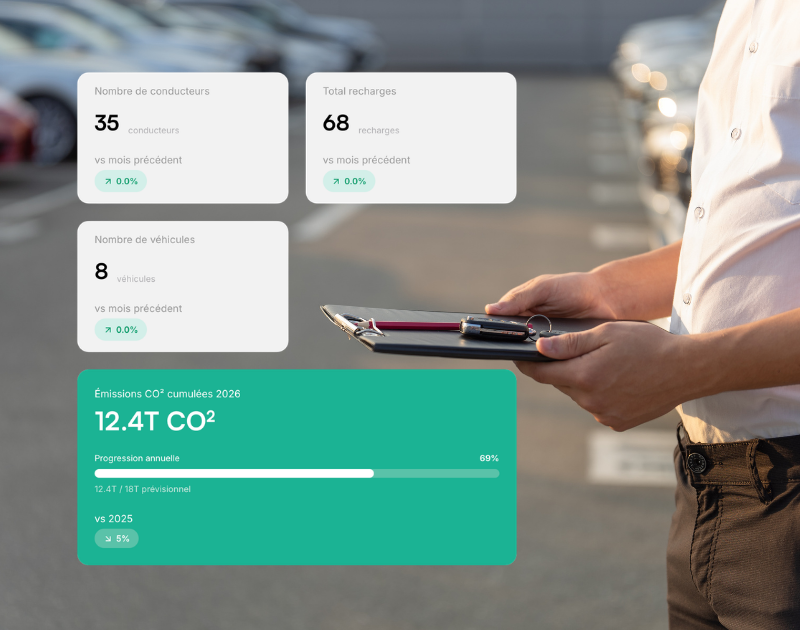
For Oriway Business, SaaS fleet management solutions must go beyond simple mileage tracking. A high-performance 360° approach now aggregates four types of critical data:
This massive consolidation allows you to anticipate cost overruns before they impact your balance sheet. TheAI integration reinforces this approach by offering recommendation scenarios: reallocating vehicles between employees, optimizing charging schedules to avoid peak electricity rates, and simulating contract renegotiations.
Sessions dedicated to “high-risk drivers” and “BIK management” serve as a reminder that safety remains a major financial and human issue in France. By leveraging driving data , companies can now:
Our observation at Oriway: the performance of a sustainable mobility policy in 2026 is measured by the quality of its data. By centralizing these flows within a SaaSecosystem, you turn regulatory requirements (LEZ, LOM) into an unprecedented opportunity for economic optimization.
At this 2026 edition of the Flotautomeetings, the conferences dedicated to “Electric commercial vehicles” and “Last-mile delivery” proved that sustainable mobility is no longer just a boardroom concept, but an operational reality. For tradespeople and logistics providers, electrification is now measured by the kilometer.
For commercial vehicles, the question is no longer whether to go green, but how to adapt the vehicle to specific business needs. Key points identified at the trade show include:
The Oriway Business approach: by leveraging charging data and telematics, we help companies move past preconceived notions. Some commercial vehicle profiles deemed "unsuitable for electric" turn out, after analyzing their actual driving cycles, to be perfect candidates for a cost-effective transition.
Urban delivery in 2026 relies on a mix of solutions: compact LCVs, micro-mobility, and hybrid SUVs for missions requiring maximum flexibility. The challenge is to combine city center access (LEZs) with customer satisfaction, while maintaining a TCO that remains competitive. Management via a SaaS platform is now the only way to oversee this complex logistical puzzle.
This year's nominees (Casawatt, Partage ma borne, fleet tracking solutions, Geoclic, Targa Telematic, Volta Back, Nelson, Drop n Plug, Waat, Oveo, etc.) illustrate a major market trend: facilitating access to charging and simplifying multi-site billing.
A true decision-support software, Nelson makes fleet electrification tangible through ultra-precise simulation data. For Oriway Business, this victory confirms our vision: added value has shifted from the object (the vehicle or the charging station) to comprehensive SaaS solutions capable of orchestrating the entire energy ecosystem.
The recap of this trade show Flotauto 2026 in Paris is clear: despite the technological buzz, the electric fleet management market remains paradoxically fragmented. Between car manufacturers, charge point operators (CPOs), telematics software providers, and energy card suppliers, fleet managers are often left facing a complex and time-consuming puzzle.
During our discussions at the show, we identified a reality on the ground: to date, there are only two serious competitors capable of offering a comprehensive approach to reducing charging costs. It is precisely in this strategic gap thatOriway Business unleashes its full potential.
In a world where every kWh counts, Oriway stands out as the trusted partner to turn sustainable mobility into a growth driver. Our SaaS solution is built on three fundamental pillars:
Smart charging data centralization
We reconcile data flows from employee homes, on-site infrastructure, and the public network. This total visibility is the only key to precise expense management and strict compliance with your Car Policy.
AI-powered decision support
We do more than just display numbers. We turn vast amounts of data into concrete actions: which sites should be prioritized for charging stations? What power capacity should be contracted to avoid overages? Which vehicles should be reassigned to optimize your energy TCO ?
Ensuring a sustainable transition
By simplifying the operational experience—through automated reimbursements and 360° supervision—we remove psychological barriers for drivers and ensure the profitability of your electrification roadmap.
The 2026 edition of the Rencontres Flotauto proved that the energy transition is no longer an option, but a race for efficiency. While the vehicles are now ready, it is software intelligence that will make the difference between a fleet that is burdened by its costs and one that masters them.
Many companies are still looking for clear, integrated, and, above all, financially-driven solutions. Oriway Business meets this need for clarity by offering a 360° SaaS platform dedicated to the performance of your fleet management.
The future of professional mobility belongs to those who know how to orchestrate their data. With Oriway, you are no longer just managing vehicles; you are driving a future-proof energy strategy.
Need to take it further? The Oriway experts are at your disposal to analyze your charging data and define your post-Flotauto roadmap together.